
Choose the right category
Salesforce route planningFor Salesforce field teams, compare whether route planning, Event creation, mobile visits, and reporting remain connected. If the requirement centres on technician dispatch or emergency scheduling, evaluate a field service platform. See the main Salesforce route planning page.
Tourvia in 4 clear answers
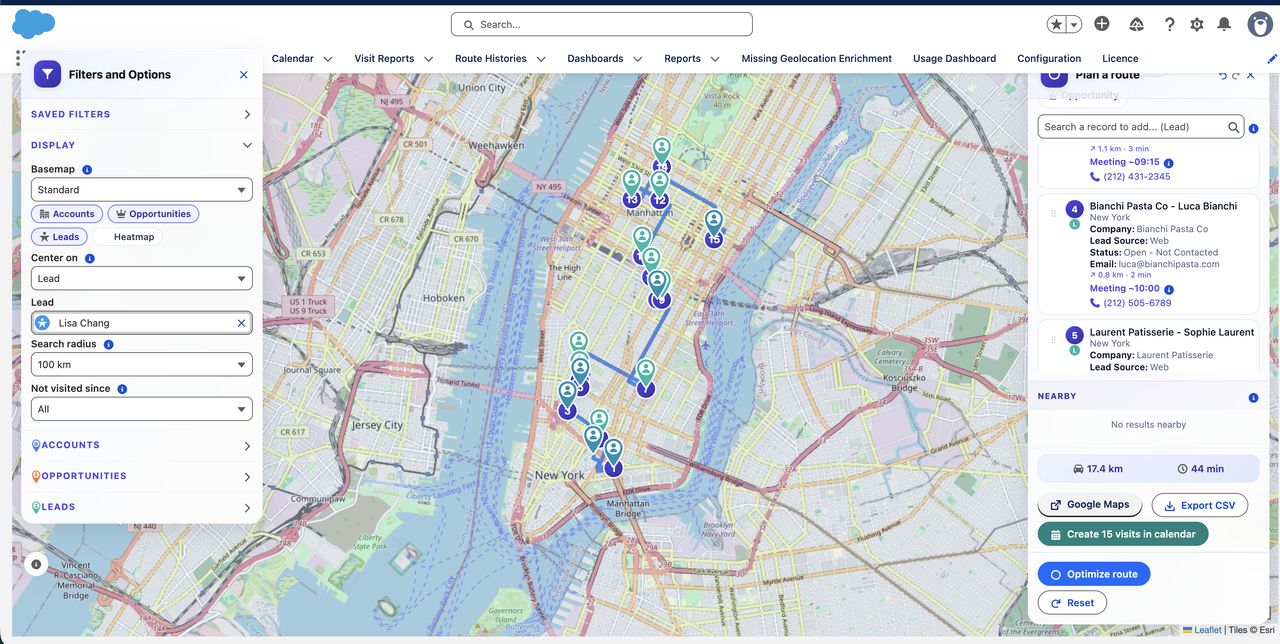
Tourvia connects account selection, route planning, Salesforce Events, field visits, and reporting.
What is it?
Tourvia is Salesforce-native route optimization software built for field sales teams that need planning and execution inside the CRM.
Who is it for?
For teams that want lower travel time, better visit density, and operational visibility without leaving Salesforce.
How much does it cost?
€30/user/month excluding tax, billed annually in that standard scope.
What is the main benefit?
Faster route planning, lower travel time, and one-click Salesforce Event creation from the optimized route.
Run the workflow during the 30-day trial
Plan routes with your Salesforce records, create Salesforce Events, and complete a field visit from the mobile app.
5.0 out of 5 on AppExchange
Based on two public reviews, verified 16 July 2026. Open the listing to read them in full.
The field sales routing challenge
Field sales teams decide which accounts to visit and in what order while accounting for travel time, working hours, customer availability and business priorities. Tourvia calculates a workable sequence from those constraints.
Most field reps solve this puzzle manually, using experience and intuition. While experienced reps develop good instincts, manual planning has inherent limitations:
- Time-consuming: account selection, route sequencing, and Event creation are repeated manually
- Suboptimal sequences: Humans struggle to find the best visiting order when more than 5-6 stops are involved
- No constraint handling: Factoring in lunch breaks, time windows, visit durations and return-to-base constraints simultaneously is extremely difficult mentally
- Static plans: Manual plans don't adapt easily when a meeting is cancelled or a new priority appears mid-day
Manual planning vs. algorithm optimization
How most field reps plan today
- Open Salesforce, check which accounts need a visit
- Open Google Maps in another tab
- Manually enter each address
- Try different orderings to minimize drive time
- Go back to Salesforce, create events for each visit
- Enter account, contact, time and address for each event
This process takes significant time and produces results that are far from optimal, especially for routes with more than a handful of stops.
How algorithm-powered optimization works
- Select accounts to visit on an interactive map (inside Salesforce)
- Set constraints: start time, end time, lunch break, visit duration
- Click "Optimize route": the algorithm calculates the best sequence
- Review the optimized route on the map
- Click "Create events": all Salesforce events are created in one click
The rep reviews one route that accounts for the configured working hours, visit durations, breaks, and time constraints before creating Salesforce Events.
Product scope
What Tourvia is built forWhen teams evaluate a switch
Field sales teams switch when manual planning wastes rep time, visit coverage becomes inconsistent, or route data has to be copied between Salesforce and another tool.
How route optimization works
Tourvia operates a constraint-aware routing engine designed for field sales workloads. It handles:
- GPS coordinates: Each Salesforce account's Latitude/Longitude (geocoded in Salesforce)
- Time windows: Start time, end time, appointment slots
- Service duration: How long each visit takes
- Break constraints: Lunch break timing and duration
- Travel time matrix: Realistic driving times between all points
The engine combines road travel times and distances with the constraints configured for the field day.
Tourvia operates the routing infrastructure in France (OVHcloud Gravelines). This means:
- No dependency on Google Maps or any paid third-party service
- No per-calculation charges
- Worldwide coverage, from Europe to Asia, Africa, Americas and Oceania
- EU-hosted routing infrastructure for organizations that care about data residency
Why CRM integration matters
Route optimization in isolation, without CRM integration, solves only half the problem. The real value comes from connecting route planning with your customer data.
CRM-aware filtering
Before planning a route, filter accounts by any Salesforce field: last visit date, account type, revenue, territory, owner. This ensures you're visiting the right accounts, not just the nearest ones.
Automatic event creation
The biggest time saver is creating Salesforce Events in bulk. After optimizing a route, one click creates all calendar events with the correct account, contact, time slot and address. No manual data entry.
Visit history and coverage analysis
When route data lives in Salesforce, managers can build reports and dashboards showing visited accounts, visit frequency, under-covered territories, and field-time allocation.
Permission-aware access
A native Salesforce route planner respects your org's security model. Reps see only the accounts they have access to. Sharing rules, profiles and field-level security all apply.
Mobile optimization for the field
Field sales reps work on smartphones and tablets, not desktop computers. A route optimization tool must work well on mobile to be useful in the field.
Key mobile capabilities
- Responsive interface: Map and controls adapt to smaller screens with a bottom-sheet panel design
- GPS geolocation: Tap a button to see all Salesforce accounts within a configurable radius around your current position
- Navigation handoff: Send the optimized route to Google Maps or Waze for turn-by-turn navigation
- Works in Salesforce Mobile: Teams can use it inside the Salesforce mobile environment instead of rolling out a separate field sales app
Nearby accounts: the impromptu visit feature
One of the most valuable field features is finding nearby accounts. When a meeting finishes early or gets cancelled, reps can instantly see which Salesforce accounts are nearby and add a spontaneous visit to their day.
Field service route optimization vs field sales
The terms "field service route optimization" and "field sales route optimization" are sometimes used interchangeably, but they describe different workflows with different priorities.
Field service: technicians, SLAs, and emergency dispatch
Field service teams send technicians to customer sites for installation, maintenance, or repair. Their scheduling is driven by service-level agreements (SLAs), equipment availability, and skill-based assignment. A broken HVAC unit in July cannot wait until Thursday because the route looks better that day. Dispatchers need to handle emergency calls mid-day, reassign jobs when a technician runs late, and track parts inventory per van.
Dedicated field service platforms like ServiceTitan and WorkWave are built for exactly this. They include dispatch boards, work order management, parts tracking, and customer self-service portals. If your team's primary job is reactive maintenance with strict SLA windows, those tools are worth evaluating.
Field sales: account visits, relationships, and territory coverage
Field sales teams visit prospects and existing customers to build relationships, close deals, and ensure account coverage across a territory. Their planning is driven by pipeline value, visit frequency targets, and geographic density. A rep might need to visit 8 accounts in Lyon this week, prioritized by deal stage and days since last contact. There is rarely an emergency dispatch scenario.
When one tool can serve both
Some organizations have hybrid teams. A medical device company might send the same rep to both sell new equipment and check on installed units. A building materials distributor might combine sales calls with delivery coordination. If these teams already use Salesforce as their system of record, a single route optimization tool inside the CRM can handle both visit types. Tourvia works for any Salesforce account-based visit planning, whether the visit is a sales call, a service check, or a delivery confirmation. The key requirement is that the accounts and contacts live in Salesforce.
Measure the result against your own baseline
Tourvia does not publish a universal ROI benchmark. Territory density, current planning habits, visit duration, and customer availability all affect the result.
Use the 30-day trial to compare four measures before and after deployment:
- weekly planning time per rep;
- distance driven per completed visit;
- visits completed per rep;
- time spent creating and updating Salesforce Events.
For 10 licensed users, Tourvia costs €3,600 excluding tax per year. Compare that fixed annual budget with the measured time, mileage, and visit-capacity changes from your pilot.
The Tourvia approach
Tourvia is delivered as a Salesforce managed package. Reps plan and execute visits in Salesforce, while route calculations are processed by Tourvia infrastructure hosted in France.
The workflow keeps route planning, Event creation, mobile execution, and reporting attached to the Salesforce records that drive the day.
What makes it different
- Salesforce workflow: Lightning components, Salesforce records, Events, reports, and Permission Set Groups
- Per-user pricing: €30/user/month billed annually at €360/user/year per licensed user.
- Tourvia routing service: Routing infrastructure hosted in France, with processing described in the DPA
- International routing: Availability depends on the road-data coverage for the relevant territory
- Multi-language: Interface available in French, English and Spanish
- EU-hosted routing infrastructure: Route calculations run on infrastructure hosted in France, which supports EU data residency goals
Built for Salesforce field teams
Tourvia is for organizations that already use Salesforce and need route optimization with predictable costs and €30/user/month.
Getting started
- Request a 30-day trial via the contact form. Validate fit inside your Salesforce org first
- Configuration: Your Salesforce admin installs the managed package and configures filters and permissions
- Adoption: Your team uses the included documentation
- Subscribe to continue: Keep the complete feature set after the trial
The customer controls the rollout timeline. Installation and configuration are documented for the Salesforce admin.
Who Tourvia is built for
Tourvia is built for Salesforce-led field sales and recurring customer visits. It is not a technician dispatch or service appointment orchestration product.
Frequently asked questions
Tourvia handles typical field sales routes and processes multi-stop plans with time, duration, and travel constraints.
Tourvia supports international routing where the required road data is available. Validate the relevant territories during the 30-day trial.
Yes. Tourvia is designed for the Salesforce Mobile App. Depending on your setup, teams can access GPS geolocation, nearby accounts, and navigation handoff to Google Maps or Waze.
Tourvia works with Account, Lead, Opportunity and Campaign Member records. It creates standard Salesforce Events for scheduled visits. No custom objects are required for basic usage.
Field service optimization focuses on technician dispatch, SLA compliance, emergency rescheduling, and parts tracking. Sales route optimization focuses on account coverage, visit frequency, territory planning, and pipeline-driven prioritization. Both benefit from algorithmic routing, but the scheduling constraints and business rules differ. Tools like ServiceTitan and WorkWave specialize in field service dispatch, while Tourvia is built for Salesforce-based sales and hybrid teams.
ROI depends on team density, travel patterns, and current planning discipline. Use the trial to measure planning time, distance per completed visit, completed visits, and reporting completeness against your baseline.
Three checks before you subscribe
Decision checklistTest the Account-to-Event workflow in your Salesforce org
Request a complete 30-day trial and validate the route-to-visit workflow with your own Salesforce records.